
反击GT Voice: Bridging digital gap to be decisive factor in global AI competition_我的网站
一 |  In a report released on Tuesday, the World Bank made an optimistic assessment that artificial intelligence (AI) could allow developing countries to do in a decade what might otherwise take a century. The report found that AI will throw developing economies a lifeline, and that the technology's greatest promise for developing countries lies not in replacing workers, but in amplifying what they can do. While advanced economies are still debating whether AI will wipe out white-collar jobs, this report serves as a critical reminder that AI is not merely a force that replaces human labor. More importantly, it acts as an amplifier that unlocks growth potential. For years, many assumed that AI penetration would primarily erode low- and mid-skilled jobs and widen development gaps among economies. Yet for most developing countries still undergoing digital transformation, AI represents far more than a choice between automation and human labor. It provides a cost-effective shortcut to remedy decades of digital infrastructure shortcomings. Many digital capabilities that once required massive capital investment, systematic infrastructure development and professional talent training can now be realized through open-weight AI tools. This dramatic reduction in technological barriers offers developing countries a rare chance to leapfrog stages of technological iteration and catch up with global development trends. In China, this "amplification effect" is unfolding in various ways. Over the past few years, new professions built around human-AI collaboration have kept emerging, while the skill sets required for traditional jobs are evolving at a rapid pace. What matters even more is that China's unique AI development path carries special reference value for other developing countries. China has already integrated AI on a massive scale into core real-life scenarios spanning manufacturing, agriculture, healthcare and education, while continuously driving down the cost of access. According to CNBC, Chinese built AI models are gaining ground, and they are gaining traction as they narrow the performance gap with leading American rivals while remaining significantly cheaper to use. This model provides the most practical, accessible entry point for developing economies stepping into the AI era, rather than forcing them to chase unattainable, high-end technical standards that are out of their financial and operational reach. With the rise of Chinese open-source and open-weight models, AI competition between China and the US has become a hot topic in the global technology landscape. Some in the West often frame this as a technological power tussle between two major countries, measured by model parameters, financing scale and semiconductor manufacturing precision. While such indicators reflect technological advancement, one shouldn't overlook the far more fundamental purpose of technology. The ultimate value of any technology lies in its ability to address shared global challenges and deliver tangible public benefits. Many developing regions are still in the very early stages of digital transformation. Truly meaningful, impactful AI capability is never cutting-edge technology locked away in a laboratory. It is technology that can step out of the lab, root itself in local realities, and deliver inclusive, accessible solutions that help these countries cross the threshold of digital infrastructure at minimal cost. It is about bringing open-weight, user-friendly AI tools into the hands of ordinary people and companies. When more developing economies are able to use AI as a lever to bridge their long-standing development gaps, the global digital divide will not be further widened by this new round of technological revolution. Instead, it will be gradually narrowed for the first time in decades. From this perspective, the outcome of global AI competition will not be determined by which country first reaches the ceiling of technological sophistication. The real decisive factor is which country can extend technological benefits to the broadest population groups and leverage AI to drive inclusive global growth. 。 公司在2026年半年度报告中提到,主营业务面临供需两端的双重经营压力,经营业绩出现亏损。受市场竞争加剧影响,公司部分嵌入式安全产品的价格及数量下降,导致营业收入同比下滑。同时,全球半导体原材料价格持续上涨、晶圆制造及封装测试环节成本不断攀升,导致营业成本降幅低于营业收入降幅,公司综合毛利率呈下降趋势。  我国商业航天首次整星出口东南亚 北京时间8月25日11时21分,长征六号丙遥一运载火箭在太原卫星发射中心发射升空,将中科卫星14星、中科卫星15星、银河航天灵知09泰国立方星等7颗卫星顺利送入预定轨道。 其中,由北京商业航天企业银河航天(北京)科技集团股份有限公司(简称“银河航天”)抓总研制的灵知09泰国立方星,是我国商业航天企业首次面向东南亚国家完成整星研制、发射及在轨交付。 银河航天表示,这也是银河航天首次完成整星及地面系统出口并在“一带一路”共建国家落地应用,证明了中国商业航天企业已具备面向海外客户提供交付、运营、教学一体化的完整解决方案能力。 华西证券表示,我国火箭、卫星产业链条完整,商业航天协作切入路径清晰,随着火箭可回收技术成熟、火箭发射成本优化,行业在星座组网需求与终端消费路径开拓下将迎来快速增长阶段,产业链上下游企业有望整体受益。 中国银河证券表示,2027年~2028年我国商业航天有望进入批量首飞与初步复用阶段;2029年民商龙头进入盈利兑现窗口,产业链制造端景气度预期大幅提升,短期聚焦卫星制造领域。 我国商业航天首次整星出口东南亚 北京时间8月25日11时21分,长征六号丙遥一运载火箭在太原卫星发射中心发射升空,将中科卫星14星、中科卫星15星、银河航天灵知09泰国立方星等7颗卫星顺利送入预定轨道。 其中,由北京商业航天企业银河航天(北京)科技集团股份有限公司(简称“银河航天”)抓总研制的灵知09泰国立方星,是我国商业航天企业首次面向东南亚国家完成整星研制、发射及在轨交付。 银河航天表示,这也是银河航天首次完成整星及地面系统出口并在“一带一路”共建国家落地应用,证明了中国商业航天企业已具备面向海外客户提供交付、运营、教学一体化的完整解决方案能力。 华西证券表示,我国火箭、卫星产业链条完整,商业航天协作切入路径清晰,随着火箭可回收技术成熟、火箭发射成本优化,行业在星座组网需求与终端消费路径开拓下将迎来快速增长阶段,产业链上下游企业有望整体受益。 中国银河证券表示,2027年~2028年我国商业航天有望进入批量首飞与初步复用阶段;2029年民商龙头进入盈利兑现窗口,产业链制造端景气度预期大幅提升,短期聚焦卫星制造领域。
二 | 绩优商业航天概念股出炉 据证券时报·数据宝统计,商业航天概念股8月以来股价平均上涨7.46%,蓝盾光电的股价涨幅居首,月内累计上涨180.9%。公司与星思半导体签署战略合作协议,双方围绕多个方向展开协同布局,合作内容涵盖相控阵天线、5G以及卫星通信模块的研发制造与商业化探索,同时推进无线传输相关解决方案的开发工作。
三 | 鸿远电子在近期获得82家机构调研,公司表示,面向商业化航天与相控阵雷达的SiP外壳已实现稳定批量供货。
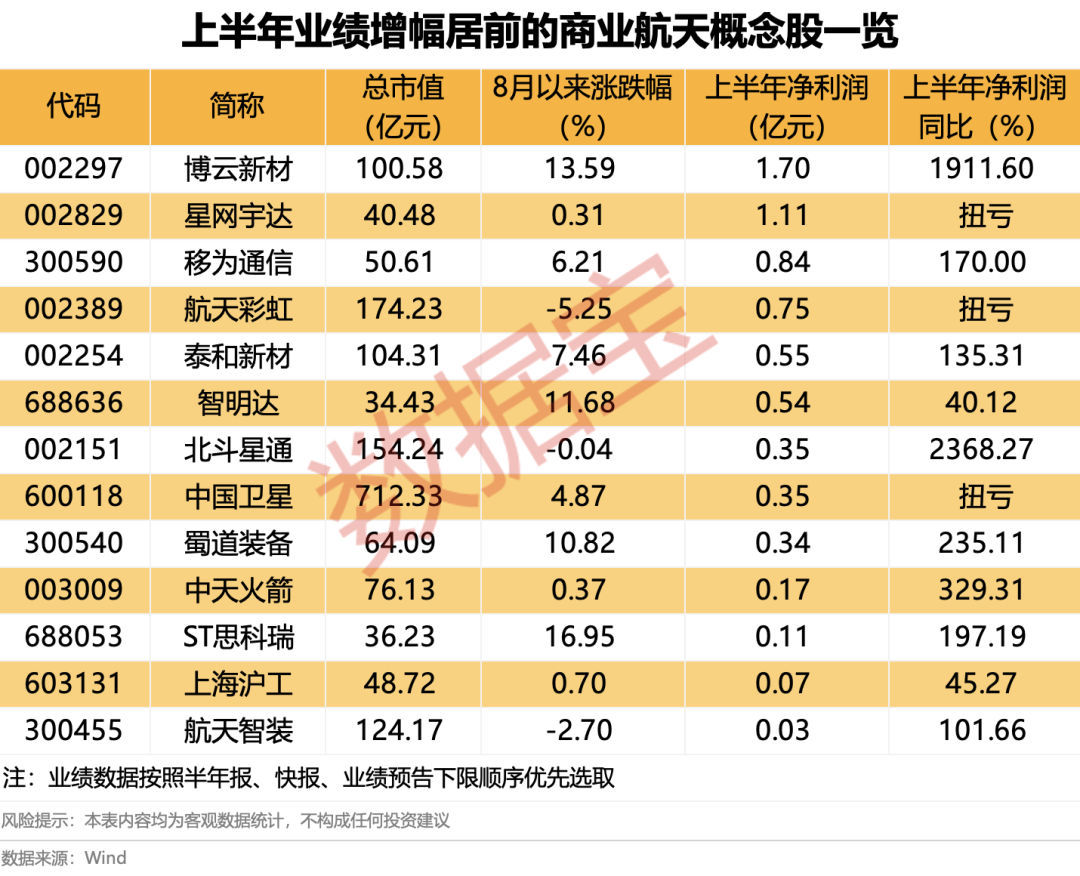
四 | 蜀道装备在机构调研活动中表示,公司将通过“产业并购+自主投资+基金孵化”多措并举,探索成为商业航天燃料综合服务商,实现从“卖设备”向“供气+服务”的模式升级。 结合业绩预告下限、快报、半年报的数据来看,中国卫星、星网宇达、航天彩虹上半年业绩扭亏。中航西飞、菲利华、火炬电子的上半年净利润规模居前,均超2亿元。 业绩增幅方面,8只概念股上半年净利润同比增幅均超100%,北斗星通、博云新材、中天火箭、蜀道装备的净利润增幅居前,分别同比增长2368.27%、1911.60%、329.31%、235.11%。 Current article:http://6n7sxd.yofateeikengyeche.cfd/news/20260826_608453.html Published on:21:11:30 |


 (文章来源:数据宝)。